
Best Hydrocolloid Bandages for Minor Burns at Home
For a cooled, unbroken minor burn, the hydrocolloid that works is the one that seals flat all the way around the wound, which makes format a bigger decision than brand. We rank five hydrocolloid formats below on four criteria: fit to the actual burn location, seal under water, how much adhesive sits on already-irritated skin, and whether you can buy it when you need it. None of this applies to deep, charred, infected or large burns, which need a clinician rather than a bandage.
We make SUPERBAND hydrocolloid bandages, so we have an obvious stake in this answer and we will say so at the top. What follows is how we would choose for a steam scald on the inside of a wrist, a splash burn on a forearm, or an oven-rack mark across a knuckle, and where our own format is the wrong tool.
Cool first, cover second
First aid comes before any dressing decision. The NHS advises holding the burn or scald under cool running water for 20 minutes, as soon as possible and within three hours of the injury, and using cool bottled water or a wet towel if no tap is available (NHS). NHS inform adds the list of things to keep away from a burn: ice, iced water, creams and greasy substances such as butter, and it warns against bursting any blisters that form (NHS inform). The American Burn Association gives the same short version for small burns handled at home: cool with running water, avoid ice, cover (American Burn Association).
Only then does a hydrocolloid become relevant. We apply ours once the area has finished cooling and the healthy skin around the burn is dry, because hydrocolloid adhesive bonds to dry skin and a damp border is the most common reason a patch lifts at the edge an hour later.
How we ranked these formats
Four criteria, applied in this order:
- Fit to the location. Can the dressing make continuous contact on the anatomy where the burn actually is? Curved surfaces such as the inner wrist, the web of the thumb and the back of a knuckle are where pre-cut rectangles fail first. Hydrocolloid dressings are flexible enough for difficult-to-dress areas including elbows, heels and knees (Osmosis), so the limit is usually shape rather than stiffness.
- Seal under water. A kitchen burn gets washed several times a day. A dressing that loosens at the border stops holding wound fluid against the wound, which is the entire mechanism.
- Adhesive load on irritated skin. Every square centimetre of adhesive sits on healthy skin. Less border means less to react to, which matters for people whose skin is already reactive.
- Cost and availability. A format you cannot buy on a Tuesday evening is not a home first-aid answer.
Hydrocolloid itself works the same way across all five: a gel-forming layer absorbs wound fluid and turns into a soft gel over the wound surface, keeping it moist instead of letting it crust (BAND-AID). The ranking below is about delivery, not chemistry.
The ranking
| Rank | Format | Best for | Main limitation |
|---|---|---|---|
| 1 | Trimmable flat sheet (SUPERBAND Cut-To-Size, $20) | Wrists, forearms, knuckles, thumb webs, anything irregular | You have to cut it, and you need clean scissors |
| 2 | Large all-purpose pre-cut patch | Roughly oval burns on flat skin: forearm, shin, back of hand | Fixed shape leaves gaps or excess on curves |
| 3 | Small contoured patch | Fingertips and single knuckles | Too small for a splash or steam scald |
| 4 | Cushioned heel and toe patch | Burns on the foot that still take pressure | Bulk gets in the way anywhere else |
| 5 | Budget multipack | Restocking a kit for predictable small burns | One shape, usually thin, edges lift soonest |
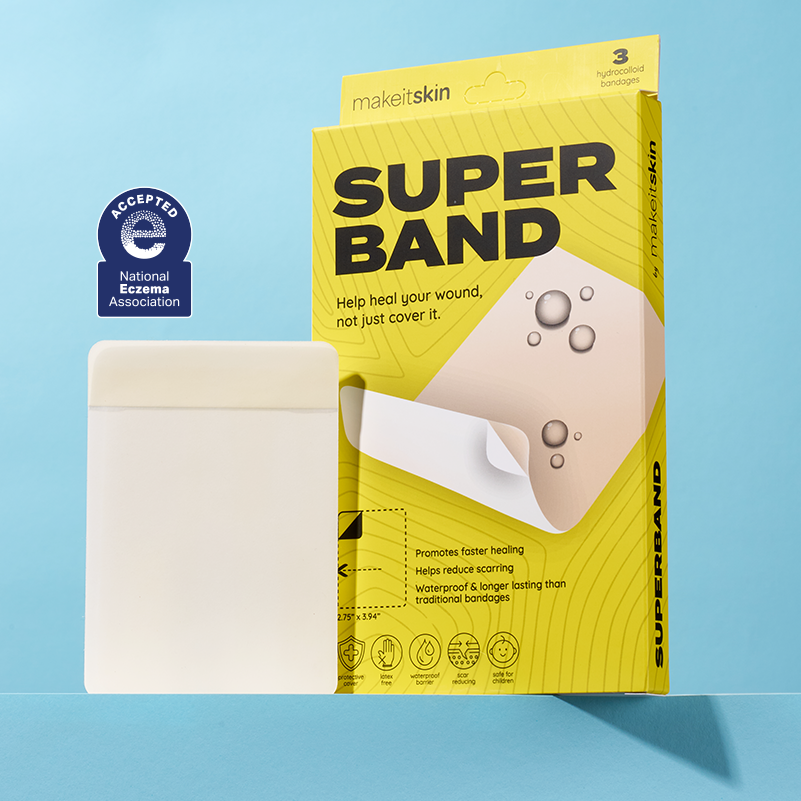
1. Trimmable flat sheets
A flat sheet is a plain rectangle of hydrocolloid you cut to the wound. For burn locations that are curved or awkward, this removes the problem the other four formats have to work around: you shape the dressing to the anatomy, cut rounded corners so nothing catches on a sleeve, and keep the border narrow on skin you would rather not cover.
SUPERBAND Cut-To-Size is our flat-sheet format at $20, and it is the reason we rank this format first on our own stated criteria rather than on brand. Pre-cut patches from other makers cover flat skin perfectly well. On the inside of a wrist, no pre-cut shape we have seen matches the curve, and a lifted edge on the first handwash ends the moist environment before it has done anything.
The trade-off is real: you need a clean cut and clean hands, and a torn or ragged edge peels faster than a factory one. Our Precision Carabiner Shears ($10) exist for that job, and the SUPERBAND Cut-To-Size Starter Kit ($25) pairs the sheets with them.
2. Large all-purpose pre-cut patches
BAND-AID Hydro Seal All Purpose and equivalent large patches are the easiest option to buy and the fastest to apply, since there is nothing to cut. On a forearm, a shin or the flat back of a hand, a large oval patch does the same job a trimmed sheet does. Check the pack size against your burn before you buy: a patch that only just covers the wound has no border left to seal with.
3. Small contoured patches
Fingertip and knuckle-shaped patches solve one specific problem well. A fingertip is a compound curve, and a shape designed for it holds better than a rectangle folded over. Nexcare and other first-aid brands sell contoured hydrocolloid shapes, and the pack will tell you which sites it was cut for. These run out of surface quickly: a steam scald that covers two fingers and the space between them needs something larger.
4. Cushioned heel and toe patches
Compeed and similar foot-focused hydrocolloids are thicker, which is useful on a burn that has to take body weight or rub inside a shoe. A dropped pan scalds the top of a foot, and padding genuinely helps when shoes have to go back on. Everywhere else the extra thickness catches on clothing.
5. Budget multipacks
Store-brand and bulk hydrocolloid packs from CURAD and similar makers restock a first-aid kit cheaply. They are typically thin, one shape and one size. For a kit that mostly sees small predictable burns, that is enough. For an odd-shaped scald, it is the format most likely to lift.
What the clinical evidence supports, and what it does not
The strongest claim we are comfortable making is about healing quality rather than speed.
In a prospective randomised trial published in Burns, Wright, MacKechnie and Paskins (1993) treated 98 outpatients with partial-thickness burns using either a hydrocolloid dressing or Bactigras, a chlorhexidine-impregnated paraffin gauze. Quality of healing was rated excellent in 56% of the hydrocolloid group compared with 11% of the conventional dressing group, and both investigators and patients preferred the hydrocolloid; the authors recommended it as a first-choice dressing for partial skin-thickness burns (Wright et al., Burns 1993).
A 2022 review in Burns & Trauma summarises three randomised trials as showing superior time to complete healing for hydrocolloid dressings over chlorhexidine-impregnated paraffin gauze, with lower reported infection, adverse events and pain in the hydrocolloid groups. The same review records a caveat worth repeating: in Wright's trial the hydrocolloid dressings needed changing more often, largely because 15% of those patients had extensive leakage against 3% on gauze (Burns & Trauma, 2022).
The counterweight matters too. The FDA's review of wound-dressing evidence summarises a 2013 systematic review of 30 randomised trials and notes that across three RCTs comparing hydrocolloid dressings with chlorhexidine-impregnated paraffin gauze, no difference was demonstrated on time to complete wound healing or infection incidence, and that the evidence was of poor quality (FDA Executive Summary). So the honest position is that hydrocolloid dressings perform at least as well as traditional gauze on healing time, with better-rated healing quality and comfort in the trials that measured those, on a small and dated evidence base.
The practical argument is sturdier than the statistical one. Paraffin-based gauze is the most common burn dressing worldwide, and the literature notes that it adheres to wounds and requires more frequent dressing changes that can traumatise newly epithelialised skin, whereas occlusive hydrocolloid dressings are associated with less frequent changes, a point made in the context of partial-thickness scalds in children (PubMed, PMID 20223327). Fewer changes means fewer chances to pull off new tissue. That is the benefit a home user actually feels.
None of this is a trial of SUPERBAND. It is evidence about the dressing class our products belong to.
When to skip the bandage and call someone
Mayo Clinic advises emergency care for a burn that goes through all layers of skin, looks dry, leathery or charred with white, brown or black patches, is larger than about 3 inches across, wraps around an arm or leg, or affects the face, hands, feet, genitals, buttocks or a major joint such as a knee, shoulder or elbow. Even a minor burn may need medical attention when it involves the eyes, mouth, hands or genitals, and babies and older adults may need care for burns that would be minor in an adult (Mayo Clinic). The American Burn Association also flags burns that worsen, become infected, or fail to start healing within a few days (American Burn Association).
Do not put an occlusive dressing over a burn that is still hot, still weeping heavily, or already showing signs of infection such as spreading redness, swelling or odour. Get it looked at.
Applying it so the seal actually holds
- Finish cooling under running water for the full 20 minutes.
- Pat the surrounding skin dry. The wound can be moist; the skin the adhesive touches must be dry.
- If you are trimming a sheet, cut it with about a centimetre of margin all around and round off the corners.
- Warm the dressing briefly between your palms, then press from the centre outward for 30 seconds so the border bonds evenly.
- Leave it alone. Change it when the white or opaque dome of absorbed fluid reaches the edge of the dressing, or when a corner starts lifting.
SUPERBAND Cut-To-Size
20.00 USD
Shop now
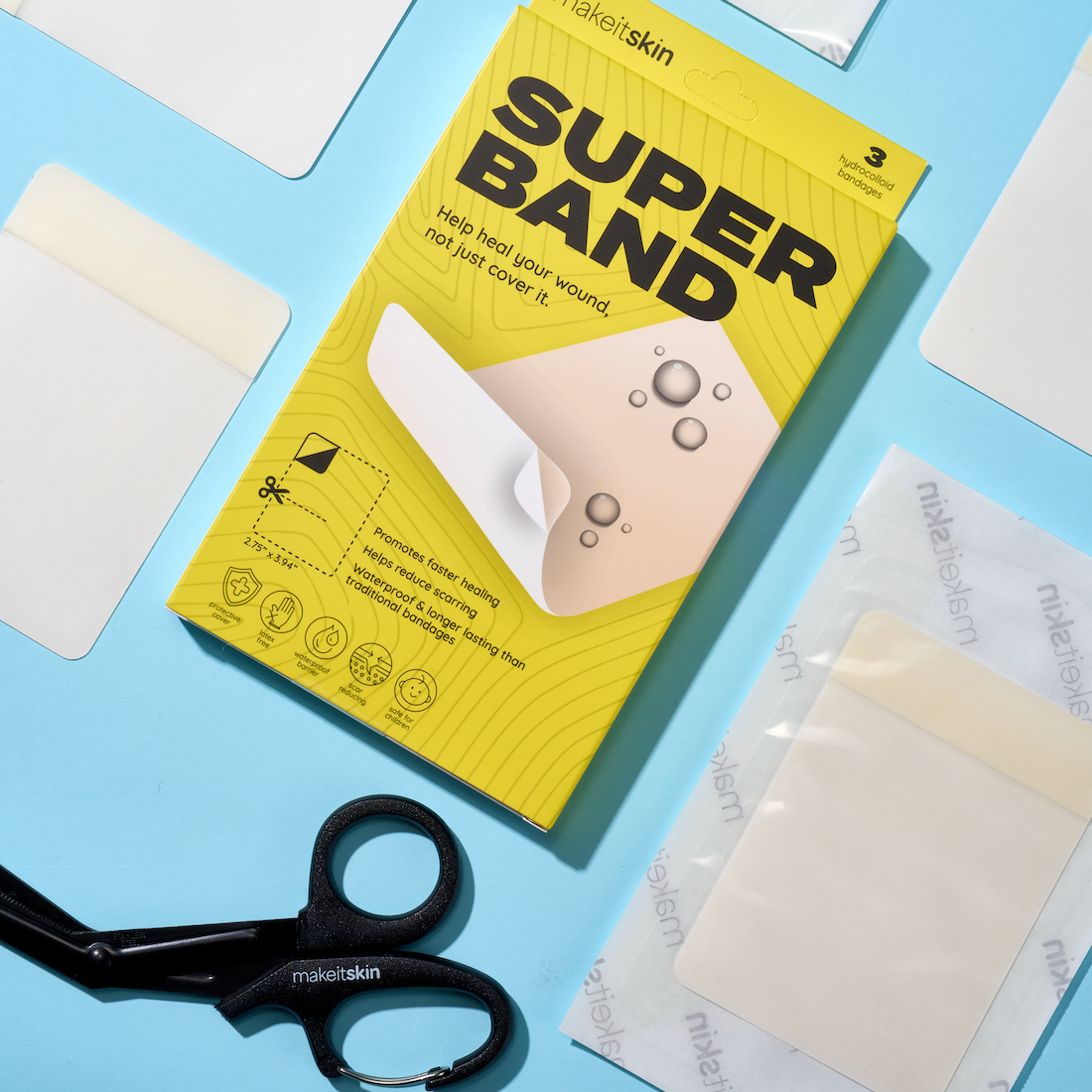
SUPERBAND Cut-To-Size Starter Kit
25.00 USD
Shop now
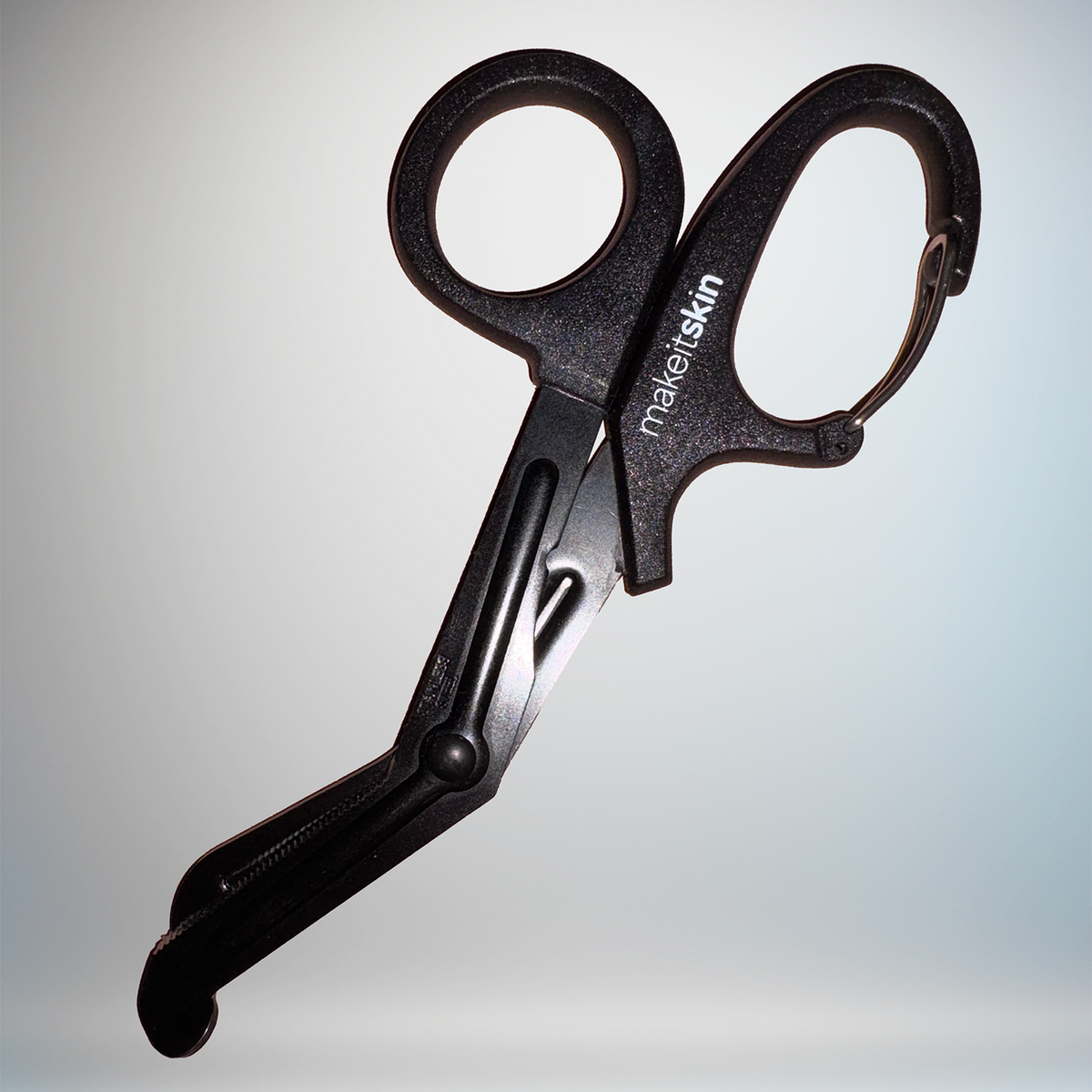
Precision Carabiner Shears
10.00 USD
Shop now
If your skin reacts to adhesives generally, our guide to choosing a gentle burn dressing for sensitive skin covers border size and removal frequency in more detail. For wound types beyond burns, see our broader breakdown of how to choose a hydrocolloid bandage.
FAQ
Can I put a hydrocolloid over a burn blister?
Leave an intact blister intact. NHS inform specifically advises against bursting blisters because of the infection risk (NHS inform). A hydrocolloid can sit over an unbroken blister as protection from rubbing, provided the dressing is large enough to seal on dry skin well outside the blister edge. A blistered burn on a hand, foot, face or major joint is a reason to have it looked at rather than dressed at home (Mayo Clinic).
How long can one dressing stay on?
Until the absorbed-fluid dome reaches the border, or the edge lifts, whichever comes first. A burn that weeps heavily in the first day or two will need changing more often than the label's maximum wear time suggests, which is exactly what Wright's trial found when leakage drove extra changes (Burns & Trauma, 2022).
Should I put ointment underneath it?
Not without direction from the product label or a clinician. Ointment sits between the adhesive and the skin and will stop the dressing sealing, and a hydrocolloid is designed to work on wound fluid alone.
Does covering a burn reduce scarring?
Covering it keeps the surface from drying into a hard crust, and the trial evidence above rated healing quality higher with hydrocolloid than with conventional gauze. We will not promise you a scar-free result. Depth, location and your own skin decide most of that.
Is this appropriate for a child's scald?
Scalds are the most common partial-thickness burn in children, and dressing choice genuinely affects how often the wound is disturbed (PubMed, PMID 20223327). Cool the burn for the full 20 minutes first, then get medical advice. The British Red Cross advises cooling a child's burn for at least 20 minutes and always seeking medical advice afterwards, because even small burns can be serious depending on the child's age and the depth and location of the injury (British Red Cross).
If your kitchen burns tend to land somewhere a rectangle will not sit, the SUPERBAND Cut-To-Size Starter Kit pairs the flat sheets with the shears you need to trim them cleanly. If they are usually small and flat, a pack of Cut-To-Size sheets on its own will do.


