
Portable Burn Bandages for Your Bag: What to Carry in 2026
For an everyday bag that has to handle minor kitchen and household burns, we rank four options: our SUPERBAND Cut-To-Size hydrocolloid sheets, a single Water-Jel 4x4 hydrogel burn dressing, a sterile non-stick pad with paper tape, and the RHINO RESCUE Burn Kit. We ranked them on which phase of a burn each one covers, how flat and light it carries, how well it fits awkward burn spots, and how many burns one carry can handle. Cool running water is still the first step for every burn, and none of these products replaces a clinician for a burn that is large, deep or on the face, hands, feet or genitals.
We make SUPERBAND hydrocolloid bandages at MAKEITSKIN, so one product on this list is ours. We kept it to a single entry and we explain below exactly what it does not do.
A minor burn creates two different carry problems
The first few minutes call for cooling, and the days afterward call for a cover that stays put. The American Academy of Dermatology (AAD) tells you to immerse a first-degree burn in cool tap water or apply cold, wet compresses for about 10 minutes or until the pain subsides. The American Burn Association advises running water for at least 5 minutes, not cold or icy water, and warns against ice, butter, oils and ointments.
That makes the cooling phase mostly a question of access to water. A product only earns bag space for this phase if you are often somewhere without a tap.
The covering phase lasts much longer. The AAD's next steps are to cover the burn with a nonstick, sterile bandage, let any blisters heal on their own while the area stays covered, and never pop them. This is the part of a burn you live with through showers, handwashing and a workday, and it is the part that cooling-focused burn dressings are not built for.
How we ranked them
We applied four criteria, in this order:
- Phase coverage. Does it cover the cooling minutes, the covering days, or both? A bag item that covers the longer phase does more work.
- Carry footprint. Is it flat and light enough to live in a purse, gym bag or carry-on without its own pouch?
- Fit. Can it cover a burn on a knuckle, inner wrist or forearm without gaps at the edges?
- Burns per carry. How many separate minor burns can one carried supply handle?
This ranking covers first-degree burns and small, minor burns you would reasonably treat at home.
The ranking at a glance
| Rank | Product | Phase it covers | Carry footprint | Main limit |
|---|---|---|---|---|
| 1 | SUPERBAND Cut-To-Size (hydrocolloid sheets) | Covering, after cooling | 3 flat sheets, 2.75 x 3.94 in each | Does not cool; needs scissors |
| 2 | Water-Jel 4x4 Burn Dressing (hydrogel) | Cooling, when water is far away | One flat foil pack | One dressing per pack |
| 3 | Sterile non-stick pad + paper tape | Covering | Small, but two items | Frequent reopening for petroleum jelly |
| 4 | RHINO RESCUE Burn Kit | Cooling and first cover | 220 x 240 x 95 mm, 340 g | Too large for most everyday bags |
1. SUPERBAND Cut-To-Size: the cover for the days after
SUPERBAND Cut-To-Size is a pack of three flat hydrocolloid sheets, each 2.75 x 3.94 inches, that you trim to fit the wound (SUPERBAND FAQ). It is listed at $20 and its product page names burns among its uses. Hydrocolloid contains gel-forming agents that absorb fluid from the wound while keeping it from drying out.
It ranks first because it handles the longest phase of a minor burn and takes up almost no room. Three sheets can be cut into several shapes, so one pack can cover more than one small burn, and a trimmed piece follows the curve of a knuckle or wrist where a fixed square leaves gaps. We design SUPERBAND to be waterproof, so it can stay on through showers and handwashing.
Use it only after the burn has been cooled. Our directions are to clean and dry the area completely, cut the sheet larger than the affected skin, and press it gently into place. The sheet absorbs fluid and swells white, which is expected, and it stays on until it starts to peel off naturally (SUPERBAND FAQ). Replace it sooner if the edge lifts or it leaks.
The clinical evidence is about the hydrocolloid category, tested with other brands. In a randomized trial published in Burns, Wright, MacKechnie and Paskins (1993) treated 98 outpatients with partial-thickness burns using either a hydrocolloid dressing or Bactigras, a chlorhexidine-impregnated paraffin gauze (PubMed). Healing time was the same, a median of 12 days in each group, according to the Cochrane review of burn dressings. A narrative review of hydrocolloids in dermatology reports that about half of the hydrocolloid group achieved "excellent" healing compared with 11% on the traditional dressing, and also that the hydrocolloid needed more changes because of leakage (16% versus 3%). The Cochrane authors rate the overall burn-dressing evidence as poor quality, so treat these results as supportive, not definitive.
The trade-off is the cutting. Away from home you need clean scissors. Our Precision Carabiner Shears ($10) have a blunt, wide tip, a blade under 4 inches and a built-in carabiner that clips to a bag strap, and the Cut-To-Size Starter Kit ($25) pairs them with a pack of sheets.
For a closer look at hydrocolloid formats for burns at home, see our ranking of the best hydrocolloid bandages for minor burns.
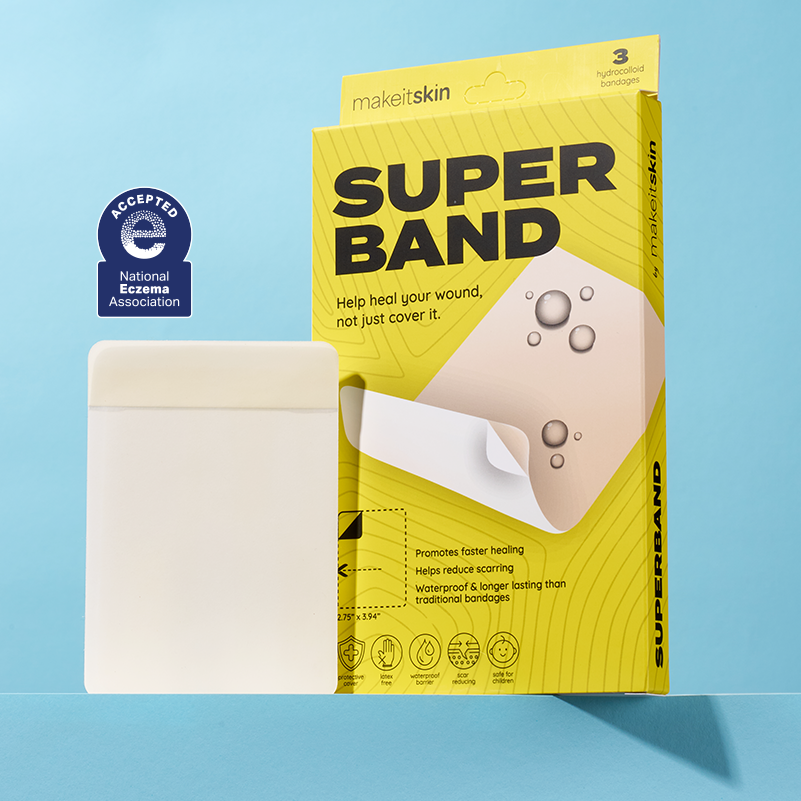
SUPERBAND Cut-To-Size
20.00 USD
Shop now
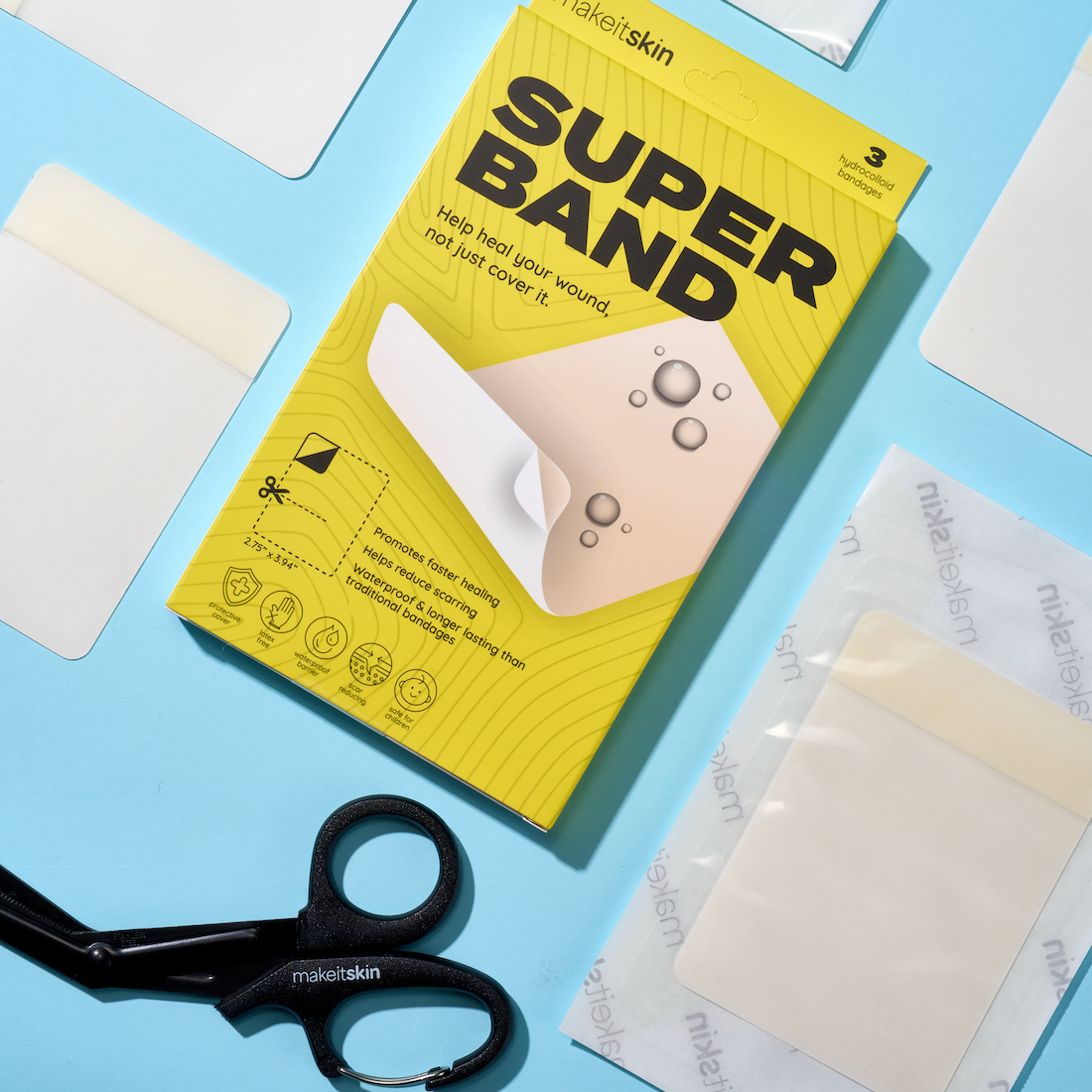
SUPERBAND Cut-To-Size Starter Kit
25.00 USD
Shop now
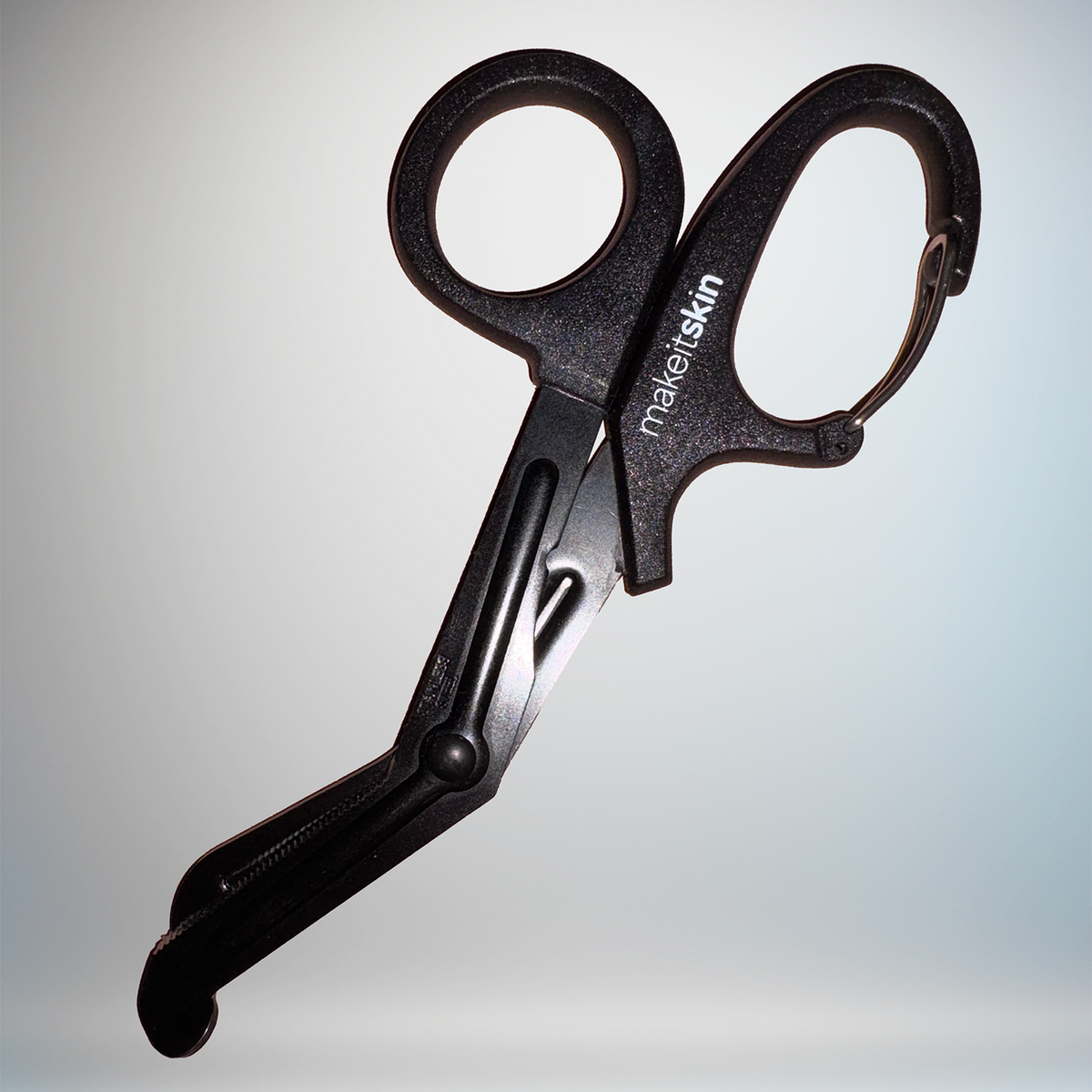
Precision Carabiner Shears
10.00 USD
Shop now
2. Water-Jel 4x4 Burn Dressing: cooling when there is no tap
A Water-Jel 4x4 is a sterile, gel-soaked non-woven pad sealed in a flat foil pack. Water-Jel Technologies lists it as a non-adherent dressing that cools the burn and helps stop the burning process, with a clear gel containing hyaluronic acid and a five-year shelf life (Airgas listing). The 4 x 4 inch size is designed to fit the palm or the back of the hand near the knuckles, both common burn sites (Rescue Essentials).
It ranks second because it is the flattest way to carry the cooling phase. That matters at a campsite grill, a picnic or a beach, where running water may be a walk away. The limit is one dressing per burn, and it is built for the emergency moment. For the days that follow, you switch to a cover such as option 1 or option 3.
If a tap or a bottle of clean water is close, the AAD and American Burn Association guidance above still puts cool water first.
3. Sterile non-stick pad and paper tape: the low-cost cover
This is the cover the AAD describes: petroleum jelly two to three times daily under a nonstick, sterile bandage. The American Burn Association similarly suggests covering loosely with sterile gauze or a clean cloth. A couple of individually wrapped pads and a small roll of paper tape cost little and fit any kit.
It ranks third on practicality away from home. Reapplying petroleum jelly several times a day means opening the dressing repeatedly, and two separate items are easier to lose in a bag. For people whose skin reacts to adhesive borders, a loosely taped pad can still be the better choice. Our guide to choosing a gentle burn dressing for sensitive skin covers that trade-off.
4. RHINO RESCUE Burn Kit: complete, but sized for a car or kitchen
The RHINO RESCUE Burn Kit is the most complete item here. Its official listing includes eight 3.5 g burn gels, four 100 x 100 mm burn dressings, four non-adherent pads, two bandages, tape, 16 cm medical shears and gloves (RHINO RESCUE). The maker says its dressings can be applied without pre-cooling the burn and that one gel pack delivers one application.
It ranks last for this question because of size. The kit measures 220 x 240 x 95 mm (about 8.7 x 9.4 x 3.7 inches) and weighs 340 g (about 12 oz), which is closer to a hardcover book than to a bag insert. It earns its place in a car, a kitchen drawer, a workshop or a group camping kit where several people share one supply.
What to pack, by bag
- Purse, work bag or carry-on: one pack of Cut-To-Size sheets and compact scissors. Most of these days are spent near a tap, so carry the cover and let the sink handle cooling.
- Gym bag: the same, since showers and sweat are what the covering days have to survive.
- Day hike, picnic or campsite: add one Water-Jel 4x4 for the cooling minutes when water is far away.
- Car or shared family kit: a full kit such as RHINO RESCUE, plus hydrocolloid sheets for the days after.
If your burns tend to happen at the sink, our dish-sink guide to waterproof burn bandages covers keeping a cover sealed through dishwashing.
When a bag kit is not enough
Some burns need care beyond anything in a bag. The American Burn Association says not to delay medical care for burns larger than a hand, and to seek care if a burn worsens, becomes infected, or does not begin healing within a few days. The AAD says to go to an emergency room if a first-degree burn is very large, if the person burned is an infant or elderly, or if you think the burn is more severe. WebMD adds burns on the hands, feet, face or genitals, a burn blister larger than two inches or one that oozes, and signs of infection such as increased pain, redness, swelling, fever or oozing.
FAQ
Can a gel burn dressing replace running water?
RHINO RESCUE says its dressings can go on without pre-cooling, but the AAD and American Burn Association both start with cool water. Use water when you have it, and keep a gel dressing for when you do not.
Is the white bubble under a hydrocolloid sheet a problem?
No. The sheet absorbs wound fluid and swells white, which our FAQ describes as part of normal use. Spreading redness, swelling or pus are different: the American Burn Association lists them as signs of infection to watch for, and they mean the burn should be seen.
Is SUPERBAND suitable for sensitive skin?
SUPERBAND is listed by the National Eczema Association as an accepted product, and the listing gives its ingredients as cellulose gum, a hydrogenated styrene/methylstyrene/indene copolymer, pectin and polyisobutene. Individual tolerance still varies, so if your skin has reacted to adhesive dressings before, test a small piece on intact skin first and stop if irritation develops.
Keep a pack of SUPERBAND Cut-To-Size in your bag for the days after a burn, or pick up the Starter Kit if you also need scissors that clip on.


