
Cuts and Scrapes: Which Bandage Helps Limit Scarring?
Share
We make SUPERBAND, and our starting point for a minor cut or scrape is simple: keep it clean, moist and covered rather than letting it dry into a scab. A sterile bandage over plain petroleum jelly is a straightforward choice recommended by the American Academy of Dermatology (AAD). Before using a hydrocolloid dressing, check its label for wound suitability and application instructions. No bandage can promise scar-free healing.
🩹 Which bandage should you choose?
Choose by coverage, fit and your skin's tolerance of the adhesive, not by a promise to erase scars.
| Option | When to consider it | Application and replacement |
|---|---|---|
| Sterile adhesive bandage with plain petroleum jelly | You want AAD's straightforward routine for a minor cut or scrape | Clean the wound, apply petroleum jelly, cover and change the bandage daily |
| Hydrocolloid dressing | Check the product's label for wound suitability before use | Follow that product's directions for preparation, coverage, application and replacement |
| Non-adhesive gauze pad with paper tape | Your skin is sensitive to adhesive bandages | AAD suggests this alternative within its moist wound-care routine |
The conventional routine and adhesive-sensitive alternative come from AAD's scar-minimizing wound-care guidance. Its petroleum-jelly instructions are not hydrocolloid application instructions. If you choose a hydrocolloid, use its own directions rather than automatically putting ointment underneath.
💧 Why moist care matters for healing and scars
A dry scab is not the goal. In AAD's scar-care guide, updated in 2025, writer Paula Ludmann, MS, explains that petroleum jelly keeps an injury from drying out and forming a scab. Wounds with scabs take longer to heal. Appropriate moist care can also help prevent a scar from becoming too large, deep or itchy. See AAD's explanation of moist wound care.
The useful distinction is moist protection versus drying out, not a guaranteed winner among bandages. This guidance does not establish that SUPERBAND heals cuts faster than petroleum jelly with a conventional bandage, or that any dressing guarantees unmarked skin.
✂️ Where our Cut-To-Size sheet fits
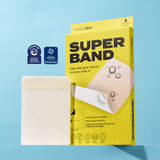
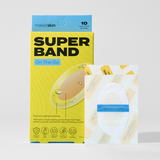
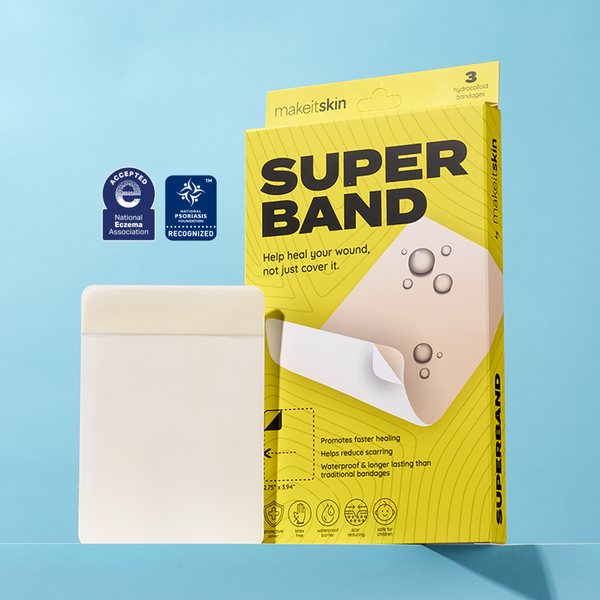
Our at-home custom-fit option, SUPERBAND Cut-To-Size, is a flat hydrocolloid sheet, not a roll. You can trim its customizable format for differently shaped minor cuts and scrapes instead of relying on a fixed strip shape. Our official Cut-To-Size product page describes the hydrocolloid material and trimmable format.
The practical reason to consider it here is fit. Before trimming, check the package directions for wound suitability and the coverage needed. Follow those directions for application and replacement; do not substitute the daily-change schedule for a conventional bandage.
🧼 Clean, cover and keep protecting it
For a minor cut, AAD's care instructions recommend this sequence:
- Wash your hands with soap and water.
- Gently clean the cut with cool or lukewarm water and a mild soap or cleanser to remove dirt and debris.
- Control bleeding by applying pressure with a clean washcloth or gauze until it stops. Get medical help if bleeding will not stop.
- Choose your dressing pathway. For AAD's conventional routine, apply plain petroleum jelly and cover with a sterile bandage. Change that bandage daily and keep the cut covered until healed. For a hydrocolloid, follow its package instructions, including skin preparation and replacement timing.
Do you need antibiotic ointment? Not routinely for a minor wound without infection signs. In its video on topical antibiotics, AAD explains that antibiotic creams and ointments can irritate skin and cause contact dermatitis. It recommends cleaning, plain petroleum jelly and covering instead when there are no infection signs. Suspected infection needs medical assessment, not simply a different ointment beneath a bandage.
Sensitive-skin troubleshooting: If adhesive bandages bother your skin, consider the non-adhesive gauze pad with paper tape suggested in AAD's wound-care guide. You do not have to choose a hydrocolloid to practice moist wound care.
☀️ After healing, shift to scar care
Caring for an open wound and caring for healed skin are different steps. While the wound is open, focus on cleaning and appropriate moist coverage. After it heals, sun protection becomes part of scar care.
AAD recommends broad-spectrum sunscreen with SPF 30 or higher after the wound has healed, with frequent reapplication. Sun protection may reduce red or brown discoloration and help a scar fade faster.
Good wound care can reduce a scar's appearance, but it cannot guarantee no mark. AAD notes that scars cannot be completely eliminated, although most fade over time. If a scar concerns you, a board-certified dermatologist can discuss ways to make it less visible.
🚩 When a bandage is not enough
Seek immediate medical care for a deep or very painful wound, as advised in AAD's scar-care guidance. AAD's minor-cut guidance also recommends immediate medical attention if bleeding will not stop. Call a healthcare professional if you notice pus or increasing redness, swelling or pain, the infection signs listed in that minor-cut guide.
If the cut came from a dirty or rusty object, AAD also advises making sure your tetanus vaccination is up to date and contacting your primary care doctor if you are unsure.
✅ TL;DR
- Keep minor cuts and scrapes clean, moist and covered rather than deliberately drying them out.
- Petroleum jelly with a sterile bandage follows AAD's conventional routine. A hydrocolloid has its own application and replacement directions.
- Choose for fit and skin tolerance. Aim to support healing and reduce a scar's appearance, not guarantee scar-free skin.
For an at-home sheet you can trim to fit, explore our SUPERBAND Cut-To-Size and check its directions against the wound you need to cover.


