
How to Remove a Hydrocolloid Bandage Gently
Share
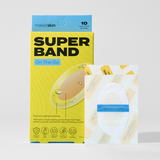
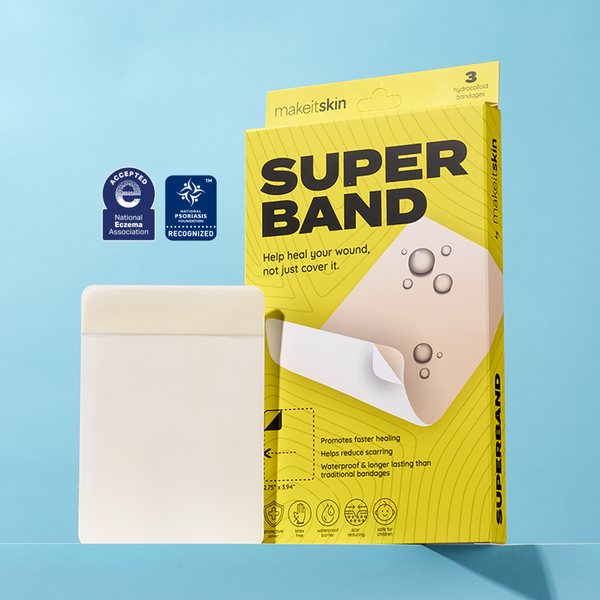
A hydrocolloid bandage that will not budge is a reason to pause, not pull harder. We make SUPERBAND, and we recommend starting with the removal directions for the exact bandage you are wearing. For SUPERBAND Cut-To-Size, our product directions specify lifting the corners up and away from the skin. If gentle removal is not working, stop and ask for help.
Follow Your Bandage's Removal Method 🩹
For our SUPERBAND Cut-To-Size flat sheets:
- Find a corner where you can begin lifting gently.
- Lift that corner upward and away from your skin, following our Cut-To-Size removal directions.
- Work gradually. If the bandage resists, pause rather than increasing the force.
Do not assume a removal technique for another hydrocolloid product applies to yours. For example, Black Country ICB's Sandwell Area Formulary guidance describes supporting the skin with downward pressure, carefully lifting the corners and stretching the edges until free for DuoDERM Extra Thin and DuoDERM Signal.
Follow your own package and any instructions your healthcare professional gave you.
If It Sticks, Pause and Recheck ✋
We recommend a simple troubleshooting sequence:
- Stop pulling if the bandage will not release gently.
- Recheck the product name and directions. Make sure you are using instructions for the bandage on your skin.
- Ask a healthcare professional for help if you still cannot remove it without forcing it.
Should you try soaking, oil or an adhesive remover? Check your exact product's instructions before adding a removal aid. If the directions do not address it, ask the manufacturer or a healthcare professional for a suitable method rather than improvising.
Check Before Covering Again 👀
Once the bandage is off, inspect the wound and surrounding skin before applying another dressing.
For superficial wounds and abrasions, the American Heart Association and American Red Cross (2024) advise removing the dressing, inspecting the wound and obtaining medical care if redness, swelling, foul-smelling drainage, increased pain or fever develops. See their first-aid guidance for superficial wounds. Do not simply cover those changes with a fresh patch. If removal is difficult and these signs are present, seek help rather than repeatedly pulling at it. For a deep wound, we recommend seeing a healthcare professional rather than following this minor-wound routine.
If another SUPERBAND Cut-To-Size bandage is appropriate, our application directions call for cleaning and fully drying the area, trimming a piece a little larger than the spot, removing the backing and pressing it on gently.
TL;DR ✅
- Follow the removal method for your exact bandage.
- For SUPERBAND Cut-To-Size, start gently at a corner using our directions.
- Pause and seek help if the bandage will not release gently.
- Inspect the wound before covering again, and get medical care for the warning signs above.
Before your next application, review our SUPERBAND Cut-To-Size directions.


